












When Miltton, a consultancy specializing in communications, stakeholder relations, sustainability, and strategy and headquartered in Finland, agreed to become the case for an Aalto EMBA Business Strategy Project, the company already knew international growth would be one of its main drivers in the future. What it didn’t yet have was a shared, systematic way to decide which markets to enter, how to enter them, and how to tell whether the entry was on the right track.
“We’ve expanded internationally throughout our history, sometimes very successfully, sometimes with more difficulty,” says Sanna-Mari Jäntti, Miltton's Head of New Markets. “But we’ve done it largely with a startup mindset – driven by opportunity, enthusiasm, and the people who happened to be involved at that moment. What we didn’t yet have was a structured playbook. This project gave us exactly that, and in a much more thorough form than we would ever have done ourselves.”
The work was carried out as part of an EMBA program at Aalto University Executive Education and Professional Development (Aalto EE). In the program’s nine-month Business Strategy Project, participants propose potential case topics, after which the most compelling ones are selected and developed further with support from Aalto University’s academic tutors. Assistant Professor Iiris Saittakari from Aalto University School of Business served as the project’s academic tutor, helping the team connect research with real-world business insight.
Miltton’s case was among those chosen. As part of his EMBA studies, Miltton Finland's Country Lead, Antti Salomaa, proposed exploring the company’s internationalization as a potential topic. It was selected from among all the proposals to become the focus of his team’s Business Strategy Project: an in-depth, research-driven collaboration between the participants, Aalto’s faculty, and Miltton’s leadership.
“For me, the project was about turning a real business challenge into a structured learning experience,” Salomaa says. “Internationalization is a complex topic; there’s no one-size-fits-all model. Working together with my peers and Aalto’s faculty helped us frame it in a way that was both academically solid and genuinely useful for our company.”
A timely business need
For Miltton, the timing of the project was close to perfect. The company had grown steadily beyond its home market, but leadership felt that the “next wave” of expansion would need to be more selective, better justified, and easier to replicate.
“Internationalization is strategically critical for our growth, but we had spent surprisingly little truly systematic time on it,” Sanna-Mari Jäntti says. “We’d made a lot of good decisions and we’d learned along the way, but we hadn’t pulled those learnings together in a way that would guide us the next time. This project forced us to pause and do that.”
That was also why Miltton welcomed the project so warmly: it promised not only a ready-to-use tool but also the reasoning behind it.
“It wasn’t just ‘here’s a template, go use it.’ The team went through academic sources, interviewed our people, interviewed customers, benchmarked other consultancies, and then tailored the model to our business. Someone actually thought about what would work for us,” Jäntti says. “We would never have done that level of groundwork on our own.”
Turning a broad question into a workable project
From the project team’s perspective, the assignment was attractive and definitely not trivial.
“We knew from the start that Miltton’s challenge was real. Lots of consulting companies struggle to scale internationally,” says Tuukka Koskinen, Chair of the Board at Supervoima Solutions, who acted as the project manager. “But the first hurdle was to narrow it down. ‘How should we internationalize?’ is way too big a question. With our academic tutor, we broke it into three research questions: how to select markets, how to enter them, and how to make the post-entry phase succeed. Once that clicked, the rest of the work started to flow.”
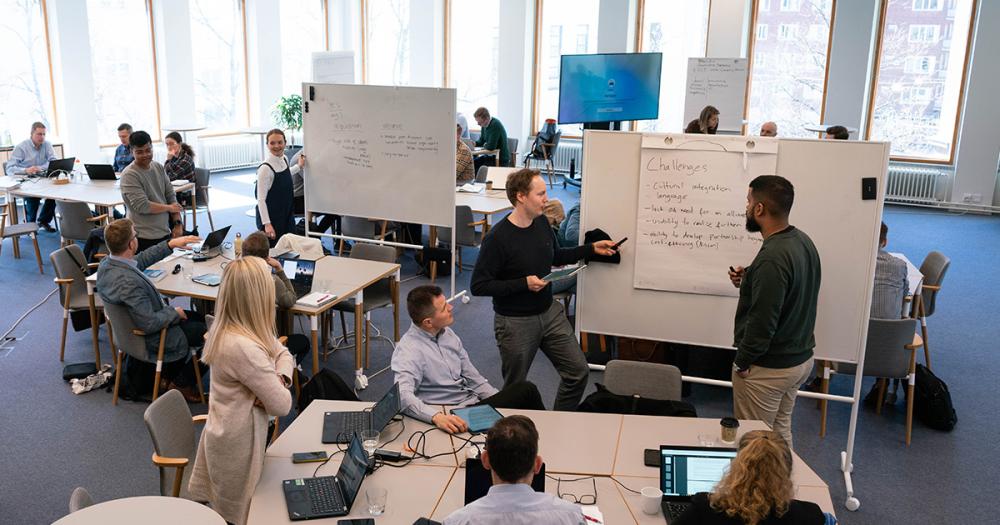
The team met weekly – 31 meetings in total – and divided the work clearly: some focused on interviews with Miltton’s leadership, employees, and customers; some on benchmarking other international consultancies; some on the theoretical frameworks (Uppsala model, Blue Ocean Strategy, Porter, Lean Startup, OKR, etc.); and some on pulling the insights together.
“What impressed me was how well the group organized itself,” says Erkki Teittinen, one of the participants, who has over 20 years of experience in developing digital products for the construction and real estate sectors. “We all had demanding day jobs, but because roles were clear, something was always moving forward. And Miltton was very open. We got to speak to people from owners to country leads. That made it possible to tailor the output.”
Another team member, Bauer Media Finland's Content Director Osku Nurmi, highlights the ‘aha’ moment with the Aalto tutor: “We had collected a huge amount of material, and it still felt a bit scattered. In one joint session, the supervisor challenged us with just the right questions, and suddenly the logic became clear. After that, we could start writing the report, not just do more research.”
The outcome: M AIM – a structured but flexible model
The team’s answer was M AIM – Agile Internationalization Model, built specifically for Miltton’s consulting business. It consists of three phases:
- Identify – define strategic criteria for choosing new markets. Instead of relying on intuition, Miltton now has questions and indicators that look at demand for its services, presence of multinational clients, regulatory conditions, and overall strategic fit.
- Probe and validate – test the market in a controlled way, choosing the right entry mode (local hires, partnerships, acquisition, or a combination) and balancing speed and risk.
- Grow – track leading indicators, not just financials. Early client engagement, strength of partnerships, and fit of offering are monitored to steer the expansion before problems show up in revenue.
The key, the team says, was to integrate theory and practice.
“None of the existing models fully fit Miltton’s business,” says Daniel Kästli, Co-Founder of wyrd, who was in charge of analyzing the interviews. “So, we combined elements from several frameworks and then used what Miltton’s own people told us to prioritize. That’s why it’s practical.”
Miltton's Sanna-Mari Jäntti agrees.
“The final report was thorough, but the tool itself was surprisingly easy to adopt,” she says. “It’s written in our language, and you can trust the process because you see how well it’s been argued.”
Already in use – and monitored at board level
Even though the implementation will take time – internationalization decisions are large by nature – Miltton has already used the model in at least one concrete case.
“Whenever we have a strategic ‘pause’ around a new market or a bigger move, the tool is on the table,” Jäntti says. “We’ve already applied it to one specific opportunity, and our board is following some of the projects that started from this. For us, that’s a sign the work has landed.”
She notes that the workload for Miltton during the project was modest compared to the value.
“It didn’t burden us much: a few rounds of interviews, reviews, and discussions. In return, we got an external view, a research-based foundation, and a practical tool. That’s a very good trade.”
Not just individual learning
A central message Jäntti wants to emphasize is that the benefit didn’t stop with Antti Salomaa, Miltton's own EMBA participant.
“Antti leads around 200 people in Finland. Any development in his thinking and leadership shows in our everyday work,” Jäntti says. “And because the topic was so business-critical, we involved our whole leadership in the reviews. Everyone now knows this tool exists and when to use it.”
She also appreciates the dual nature of the Aalto EMBA.
“It’s both a serious academic exercise and a very hands-on leadership program. That combination is important for us. We don’t just want people to learn new tools, we want them to learn how to think better. This project did exactly that.”
The experience was positive enough that Miltton has already decided to send another senior person to the program.
What the participants took away
For the project team, the assignment was a demanding but rewarding “real-life” case.
- They learned how to scope a fuzzy business problem into something researchable.
- They got to apply strategy and internationalization frameworks to an actual company.
- They experienced working in a diverse, cross-company team where everyone brought a different strength.
- And they saw their work actually being used.
“Maybe the best feedback was when Miltton told us straight that this was useful for them,” Osku Nurmi says. “That’s exactly what you hope for in a project like this.”
Tuukka Koskinen puts it more generally: “This kind of project shows why it’s worth it for companies to offer themselves as Business Strategy Project client cases. You get a motivated, senior team, access to Aalto’s academic guidance, and in the end, something you can really implement without having to reveal your most sensitive business details.”
A playbook the company wouldn’t have built alone
Looking back, Miltton sees the project as both a concrete deliverable and a culture-building moment.
“We breathed and lived this process in management,” Jäntti says. “It made us stop, reflect on past internationalizations, and agree on how we want to do it in the future. And we now have a tool we can pull out every time a new opportunity comes up. For us, that’s very valuable.”
“In that sense,” she adds, “this wasn’t just Antti’s development journey. It clearly benefited the whole company, and will continue to do so in the future, too.”
|
Aalto EMBA Business Strategy Project |